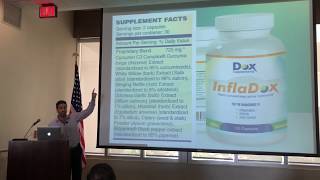
Lecture: How to evaluate supplements
Over the past twenty years of practice I have evaluated thousands of supplements; something I have truly enjoyed. I recently gave a grand...

Islon Woolf MD
Jan 27, 20191 min read


786 471 8955 (Call or Text)
786 524 8204 (Fax)


Patients Are Vulnerable to False Claims
Healthcare is filled with thousands of claims, most of which are untrue. Unfortunately, the technical complexity of medical science leads many patients to believe they are incapable of evaluating claims for themselves. They end up relying on others - who are often biased - to do it for them, leaving them vulnerable.
Evaluating Claims for Yourself
Fortunately, evaluating a medical claim is not as difficult as it seems. It can be simplified into a process that can be applied to any claim and fed into AI. The goal of this blog is to teach you this process so you can move past biased advice and evaluate claims for yourself.
The Process
The strength of any claim is proportional to the strength of evidence that supports it.
Evidence in medicine falls into just a few well-defined categories.
Each category is predictably reliable and can be ranked into a hierarchy (see below).
Therefore, to evaluate a claim, search for the evidence, identify the category it belongs to, and the higher the category, the more likely the claim is true.

Less Than 1% of Claims From the Bottom Work
How unreliable is the evidence at the bottom? The pharmaceutical industry uses these categories to generate new drugs; however, less than 1% end up working. This is the success rate from the best scientists, with the greatest resources, and the most money on the line. It's likely the success rates in other hands, or for more biologically challenging areas, like longevity, are even lower.
Evidence That Supports Every Claim Supports No Claim
The hierarchy is pyramid-shaped. The categories at the bottom are not only unreliable, but because they are cheap and easy to produce, they are plentiful. This is why the health and wellness industry loves them: you can find an anecdote, rat study, or expert to support ANY claim. However, this abundance renders these categories close to useless. Evidence that supports every claim supports no claim.
Value the Process, Not the Outcome
The health and wellness industry are not the only ones that want their claims to be true. We all want to live long and healthy, and we tend to make exceptions for outcomes we desire. OUR anecdotes, OUR rat studies, and OUR experts ARE reliable. Critical thinking is not just about bias in others, it's about bias in ourselves. Of all the skills in critical thinking, learning to value the process over the desired outcome, is the most challenging.
Find our most recent posts and a sign-up form below.
Also, don't hesitate to explore Dr Woolf's lectures on YouTube.